Threaded vs Square Hole Rack Rails: What’s the Difference and Which Should You Use?
When most people think about building out a studio rack, their attention jumps straight to the fun parts: the preamps, the converters, the power conditioners, the boutique compressors with more knobs than necessary. But ask anyone who’s been setting up racks for more than a few months, and they’ll tell you the truth that newcomers often overlook:
The rack rails you choose will shape your workflow more than you expect.
Threaded holes and square-hole rails might seem like tiny technical side notes in the bigger picture of a studio build, but they influence every install, every teardown, every emergency swap, and every late-night reconfiguration. They determine whether the simple act of mounting gear feels quick and smooth.
Here at Gear Hive, we proudly provide both options with industry leading and renown Penn Elcom rails and felt that we should give an overview of these options should you find yourself with a cart full of items and second guesses. This guide breaks down the real, practical differences between threaded rack rails and square-hole rack rails with cage nuts, focusing more on studio environments rather than server rooms.
Let’s get into it.
What Are Threaded Rack Rails?
Threaded rack rails have holes that are pre-tapped with a specific screw thread. Common thread types include 10-32, 12-24, and M6. Hear at Gear Hive, our threaded rails are tapped at 10-32. The threads are cut directly into the rail, so mounting gear requires only a screw and a screwdriver.
Threaded rails are widely used in:
Audio-specific racks
Portable road cases
Home and project studios
Traditional broadcast installations
Advantages of Threaded Rails
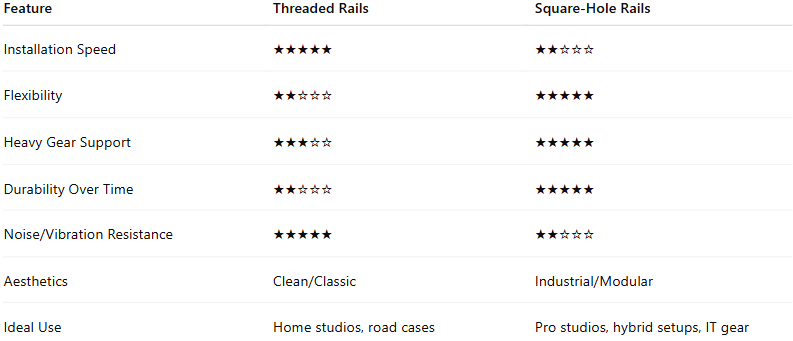
The primary advantage of threaded rails is speed. Gear can be mounted quickly without additional hardware. This makes them ideal for racks that are installed once and rarely changed.
Other benefits include:
Fewer loose parts to manage
Clean appearance
Excellent resistance to vibration
Quiet operation in mobile racks
Threaded rails are straightforward and familiar to most audio professionals.
Limitations of Threaded Rails
The main drawback is durability over time. Because the threads are part of the rail, repeated installation and removal can wear or strip them. Once a hole is stripped, repair options are limited and often require rail replacement.
Additional limitations:
Only one thread type is supported
Cross-threading is easy if screws are misaligned
Less forgiving when gear mounting holes are slightly off
Threaded rails work best in stable setups where gear changes are infrequent.
What Are Square-Hole Rack Rails?
Square-hole rack rails use uniform square openings instead of pre-threaded holes. These openings accept cage nuts, which are small metal nuts held in place by a spring clip. The cage nut provides the threads, not the rail itself.
Square-hole rails are common in:
Server racks
IT and data center environments
Modular studio furniture
Hybrid audio-IT installations
Cage nuts are available in 10-32, 12-24, and M6, making square-hole rails highly adaptable.
Advantages of Square-Hole Rails
The biggest advantage is flexibility. A single rack can support multiple thread standards simply by changing cage nuts. This is especially useful in studios that combine audio equipment with networking gear, power systems, or servers.
Other advantages include:
Replaceable threads if damaged
Improved tolerance for alignment issues
Long-term durability in frequently reconfigured racks
Square-hole rails are designed for environments where change is expected.
Limitations of Square-Hole Rails
Square-hole rails require more setup time. Cage nuts must be installed before mounting gear, which slows down the process compared to threaded rails.
Additional considerations:
Small hardware parts can be misplaced
Lower-quality cage nuts may rattle
Less common in mobile or touring racks
More industrial appearance
Despite these drawbacks, many professionals prefer square-hole rails for permanent installations.
Which Rack Rail Type Is Best for Your Studio?
Home and Project Studios
Threaded rails are usually the best choice. Most audio gear uses 10-32 screws, and home studios typically do not change equipment often. Threaded rails are simple, clean, and reliable.
Professional Recording Studios
Square-hole rails are better suited for professional environments where gear rotates frequently. The ability to replace cage nuts and switch thread standards extends the life of the rack and reduces maintenance issues.
Live Sound and Touring Racks
Threaded rails are preferred due to their vibration resistance and faster installation. Cage nuts are more likely to loosen or be lost during transport.
Hybrid Audio-IT Racks
Square-hole rails provide the most flexibility. They support audio gear, servers, shelves, and power equipment in a single enclosure without compatibility issues.
Conclusion: Which Rail System Is Truly Better?
There’s no universal winner—only what’s right for your workflow.
Choose threaded rails if you want:
Simplicity
Quick installation
Minimal moving parts
A clean aesthetic
Stability in mobile environments
Choose square-hole rails if you want:
Maximum flexibility
Replaceable threads
A rack that can evolve with your studio
Compatibility with gear from multiple industries
Rack rails may not be glamorous, but they’re one of the most influential choices you’ll make in a studio build. The right rails allow smoother installs, cleaner maintenance, and fewer headaches over the long haul.
Make the choice that supports the studio you have—and the studio you plan to grow into.